
· 4 min read
The three hour morning, and why we try not to interrupt it
A Montessori morning is one long uninterrupted stretch rather than a timetable of activities. What that looks like from the doorway, and why the restless hour in the middle of it is the part that matters.
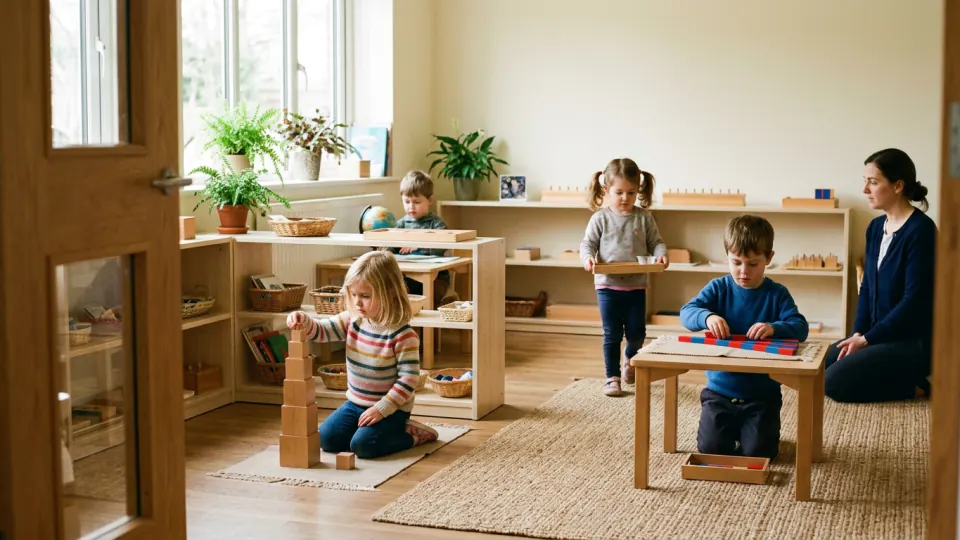
If you visit us at half past nine, you will probably think the room is chaotic. Children are moving, some are talking, two are carrying a table between them, one is doing something inexplicable with a jug of water. If you come back at half past ten, the same room will be so quiet you will lower your voice.
That is not luck, and it is not us tightening the discipline between visits. It is the shape of a Montessori morning, and it is the single thing that most often gets designed out of a nursery day without anyone noticing what has gone.
One long stretch, not a timetable
From arrival until lunch, the children have one uninterrupted block. Nobody is called away for a group activity at ten, nobody is stopped for a snack at half past. Snack is laid out and stays out, and children go when they are hungry, which means the child in the middle of something does not have to abandon it in order to eat.
A three year old given ten minutes and then moved on learns that anything they begin will be taken away from them. What they take from the day is that nothing is worth getting properly into. It is a hard habit to undo later, and school reports it as not being able to stick at things.
The restless hour is the point
Roughly an hour in, most Montessori rooms fall apart a little. Children drift, materials get carried around without being used, the noise goes up. It looks exactly like the moment an adult should step in with a song and a circle.
Maria Montessori named this and argued the opposite. If the room is left alone, that restlessness resolves on its own, and what follows is the deepest and calmest work of the day. Step in with an activity and you get a well behaved room for fifteen minutes, and you never get the hour that was coming.
So the hardest part of our morning is not managing the children. It is the adults sitting on their hands through the difficult twenty minutes.
What the adults are doing
Mostly watching. An adult in the room is looking for the child who has not chosen anything for a while, the child who has chosen something too easy for them, and the child who is ready to be shown something new. That is where the teaching goes: into short, precise, individual lessons, given to one child at the point they can use it.
It is also why you may not see anyone obviously teaching. A good morning here has very little instruction in it and a great deal of attention.
Why we do not say "good boy" very much
A child who has just poured water between two jugs without spilling it knows they did it. They can see the jug. When an adult adds "well done, clever girl", the interesting thing quietly moves from the water to the adult's approval, and the next pour is done while looking up to check.
We would rather describe than praise. "You carried that all the way across the room without spilling it" tells a child what they did and leaves the satisfaction where it started. This is not coldness. It is the difference between a child who works because it is absorbing and a child who works to be told they are good.
What this means for you
Your child will very often not be able to tell you what they did today. This worries parents and it should not. Deep concentration is not stored as an anecdote, and "we played" is what a three year old says about two hours of intense work with the number rods.
What you may notice instead is at home: a child who wants to do their own shoes and will not be helped, who gets furious if you finish something for them, who carries their plate to the sink unprompted. That is what the morning is producing. It shows up in your kitchen rather than in a conversation.
An honest caveat
This is what a good morning looks like. Not every morning is a good one. There are wet Tuesdays in February when six children have colds and nothing settles at all, and there are days we get the judgement wrong and step in when we should have waited. Any nursery telling you otherwise is describing a brochure rather than a building.
The three hour morning is what we protect and what we are trying to get right, most days, with real children. If you want to see whether we manage it, come between half past nine and half past eleven, which is the honest window. That is when there is something to see.
If any of that sounded like what you want for your child, come and see whether we manage it in practice.
Request a visit