
· 4 min read
Settling in: what the first few weeks really look like
Starting nursery is a bigger change for a two year old than most guides admit. What we do over the first few weeks, what usually happens in week two, and what helps at home.
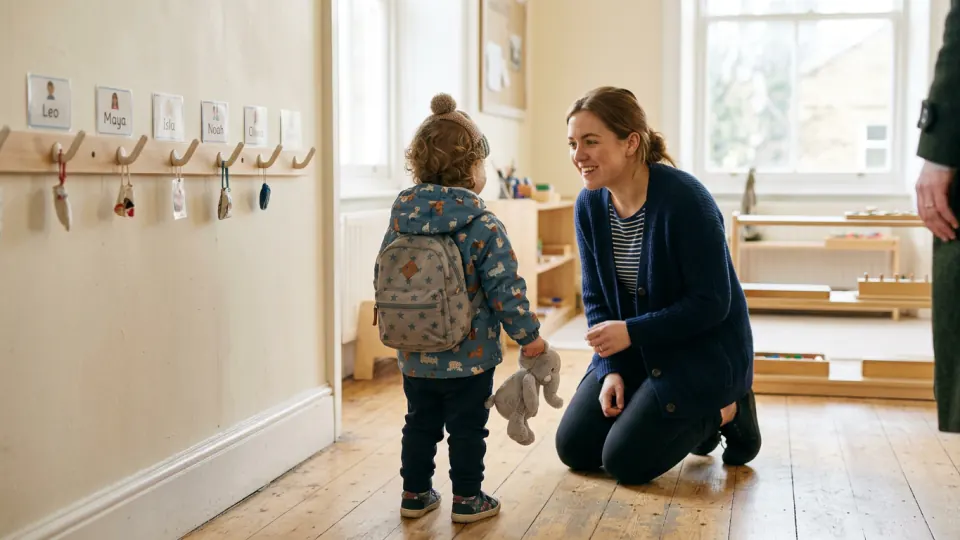
Most guides to starting nursery are written to reassure you. This one is written to tell you what actually happens, because the reassuring version leaves parents unprepared for the ordinary parts and convinced something has gone wrong.
The first visits are short on purpose
Before your child starts properly, they come in with you for a short visit, then a slightly longer one, then one where you go and come back. The point is not the time in the room. It is that your child learns something specific and useful: you leave, and then you come back. That is the whole lesson of settling in, and it cannot be taught in one long day.
A child who has had a happy three hour first session and no experience of being collected has learned nothing yet. A child who has been left for twenty minutes and collected, twice, has learned the thing that matters.
The goodbye is short, and it is said
We will ask you to say goodbye clearly and then go. Not to linger at the door, and not to slip away while your child is distracted.
Slipping away is tempting because it avoids the crying. It also teaches your child that you might vanish at any moment, which is why the child who was fine on Monday is clamped to your leg on Thursday. A goodbye that hurts for ninety seconds is kinder than a disappearance that makes the whole room unsafe.
Ninety seconds is not a figure of speech. Most children stop within two minutes of the door closing, and we will tell you honestly if yours did not.
Week two is often harder than week one
This surprises almost everyone. The first week is carried along by novelty. In the second week the novelty has gone and your child works out that this is not a one off outing, it is a thing that happens now. That is usually when the crying starts, or restarts, and when parents begin to wonder whether they have made a mistake.
You have not. The second week wobble is the most ordinary thing in early years, and it is a sign that your child has understood the situation, not that they are unhappy in it. It generally passes within a fortnight.
What we do not do
We will not tell you your child was fine all day when they were not. If your child cried for forty minutes, you will hear that, along with what settled them and what we intend to try tomorrow. A parent who is told everything was lovely and then finds out otherwise has lost something that is difficult to get back.
We also will not push a child into activities to make them look settled. A child standing at the edge of the room watching is not doing nothing. Watching is how most children work out what the room is for, and it can take days. That is fine.
What helps at home
- Keep the mornings dull. A calm, slightly early, slightly boring morning does more for settling in than anything said at the door.
- Do not over sell it. "You are going to have so much fun" sets a standard the first week will not meet. "You are going to nursery, and I am coming back after lunch" is true, and being true is what makes it useful.
- Say when you are coming back, in their units. Two year olds do not have three o'clock. They have after lunch, after the garden, after sleep.
- Send the scruffy jumper. Something of yours or of home is worth more than a new comforter bought for the occasion.
- Expect the tiredness to land at home. Children hold themselves together all day and let go with you. An awful teatime in week one is a sign of effort, not misery.
When to talk to us
Come and find us if the crying is not shortening after three or four weeks, if your child stops eating or sleeping at home, or if you simply have a feeling you cannot name. You will not be the anxious parent. You will be a parent who noticed something, and we would far rather hear it early.
Settling in is not a test your child passes or fails. It is a relationship being built between your child and one adult here who knows them, and relationships take the time they take.
If any of that sounded like what you want for your child, come and see whether we manage it in practice.
Request a visit